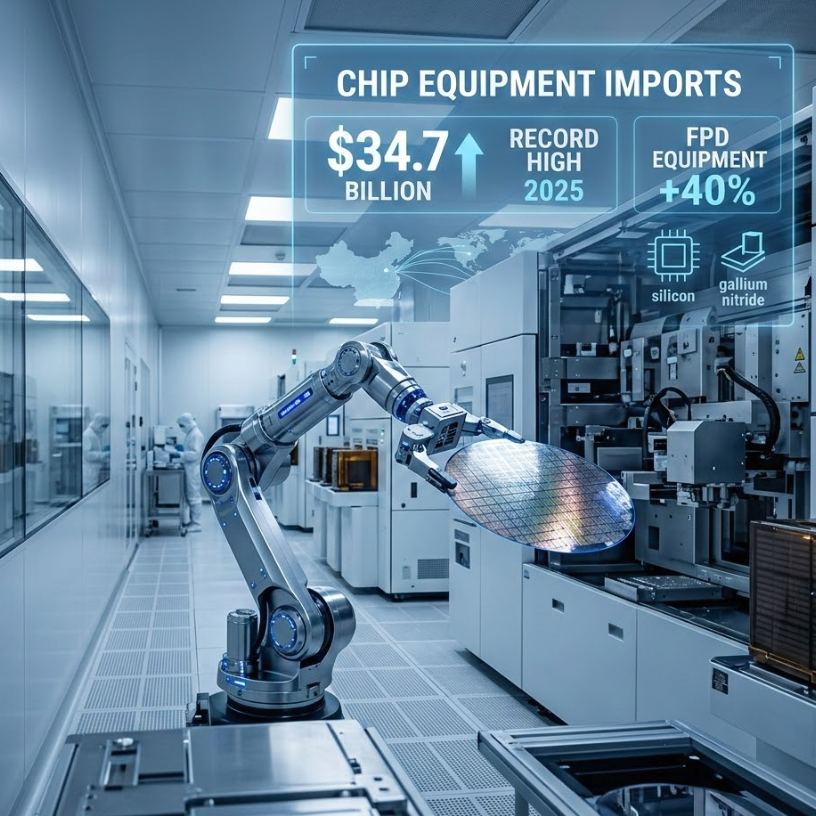
STMicroelectronics is taking significant steps to solidify its leadership in the power semiconductor market by expanding its Gallium Nitride (GaN) business and accelerating the transition of Silicon Carbide (SiC) production to eight-inch (200-millimeter) wafers. This strategic move aligns with the increasing global demand for high-efficiency power electronics in electric vehicles, artificial intelligence data centers, and renewable energy systems.
A key highlight of this expansion is the new strategic collaboration with Innoscience, a leading provider of Gallium Nitride on Silicon (GaN-on-Si) technology. Starting in April 2025, the two companies will jointly develop and manufacture Gallium Nitride products. Initially, STMicroelectronics will utilize Innoscience’s advanced manufacturing facilities in China as a foundry to produce ST-standard Gallium Nitride devices. By 2027, the partnership aims to establish a dedicated joint production line within ST’s Catania facility in Italy. Innoscience brings valuable expertise to this venture, having already achieved mass production of eight-inch Gallium Nitride on Silicon wafers.
Simultaneously, STMicroelectronics is transforming its Catania site into a world-class Silicon Carbide Campus. This fully vertically integrated facility will manage everything from research and development and substrate production to front-end wafer fabrication and back-end module assembly. A major milestone in this transformation is the shift from six-inch (150-millimeter) to eight-inch (200-millimeter) Silicon Carbide wafers, with production set to begin in the fourth quarter of 2025. This transition to larger wafers is expected to significantly improve manufacturing efficiency and reduce costs, making high-performance power semiconductors more accessible for mass-market electric vehicles.
The integration of Gallium Nitride and Silicon Carbide technologies into a single manufacturing ecosystem positions STMicroelectronics to offer a comprehensive portfolio of wide-bandgap semiconductors. These materials offer superior performance over traditional silicon, including higher switching frequencies, lower energy losses, and better thermal management. As the industry moves toward eight hundred-volt (800V) electric vehicle platforms and more energy-intensive AI infrastructures, ST’s dual-track strategy ensures it remains at the forefront of the next generation of power electronics.